The Psychology of Colour in the Office: Can Workplace Design Improve Mood and Productivity?


Colour is often treated as the finishing touch in workplace design: something selected after the layout, furniture and lighting have been decided.
In reality, colour forms part of the environment employees experience throughout the working day. It can influence how stimulating, comfortable, calm or visually demanding a space feels. However, the relationship between colour and productivity is more complex than popular claims such as 'blue improves concentration' or 'yellow makes people creative.'
Scientific research suggests that colour can affect emotional responses, alertness, attention and perceptions of a space, but its impact depends on context, saturation, brightness, lighting, personal preference, culture and the type of work being completed.
Why Colour Matters in Workplace Design
Employees do not experience colour in isolation. They experience it alongside daylight, artificial lighting, furniture, materials, acoustics, temperature and spatial layout.
This matters because the overall physical environment can affect workplace satisfaction, wellbeing and perceived ability to work effectively. Research conducted in real working environments has found that lighting and colour conditions are associated with employees' mood, particularly when spaces are experienced as visually extreme, overly colourful or poorly balanced.
Colour can influence a workplace in several ways:
It changes how bright, warm, spacious or enclosed a room appears
It can contribute to calmness or visual stimulation
It helps distinguish different workplace zones
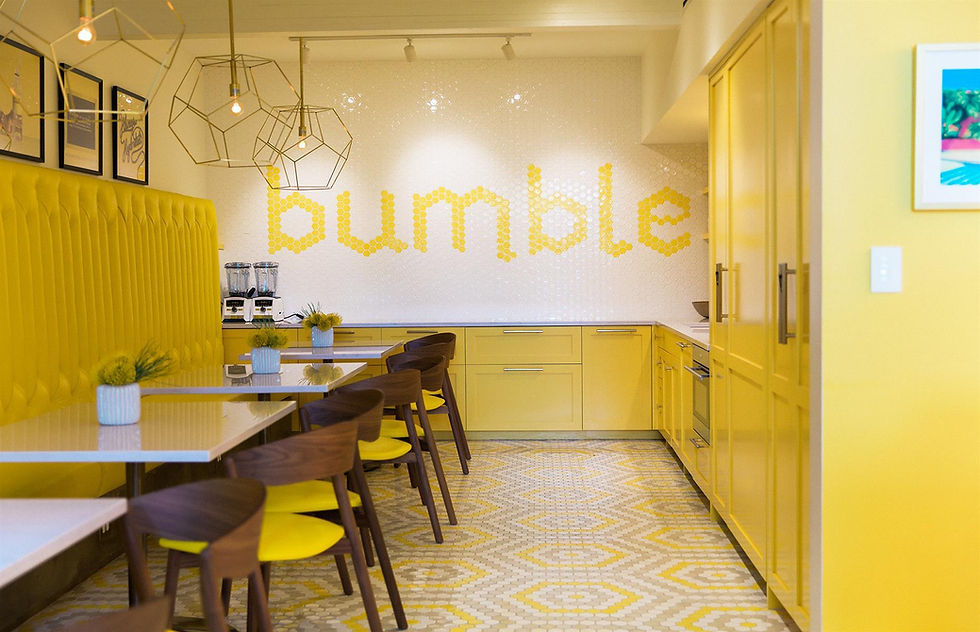
It reinforces brand identity and organisational culture
It affects how welcoming and comfortable employees perceive a space to be
The goal should not be to find one universally 'productive' colour. It should be to create an appropriate level of stimulation for the people, activities and atmosphere within each area.
What Does the Scientific Evidence Show?
Research into environmental colour has produced some valuable findings, but it has also produced conflicting results.
In a classic office experiment, participants worked in red, green or white rooms. The red environment was expected to increase tension and errors, yet participants in the red office made fewer errors than those in the white office. This demonstrated that simple assumptions about individual colours do not always predict actual performance (Kwallek. N, Lewis. C.M., 1990).
A later study examining red, blue, green and white office environments found that office colour did not significantly change overall proofreading performance. However, participants made more errors in the white office than in the red and blue conditions. More saturated environments were also associated with greater feelings of vigour (Costa. M, Frumento. S, Nese. Mattia, Predieri, I, 2018).
More recent workspace research has continued to show that different colour conditions can affect positive and negative emotions, although psychological and performance results are not always consistent. One 2026 study found higher positive affect in blue and yellow conditions, higher negative affect in red, and lower measured productivity in its green condition (Li, T. Zhang. Y, Pondo. J, Li. Z, Wang. X, 2026). These findings underline an important point: effects observed in one experimental setting should not be turned into universal design rules.
The wider scientific literature therefore supports a cautious conclusion: colour can influence workplace experience, but no colour guarantees a particular behavioural or productivity outcome.
Continue reading our colour series to discover each colour.


Comments